Lauca National Park – a World Biosphere Reserve
We leave the village of Putre before sunrise, stopping for breakfast with a 79-year-old llama herder before continuing into Lauca National Park. The first view stops us cold.
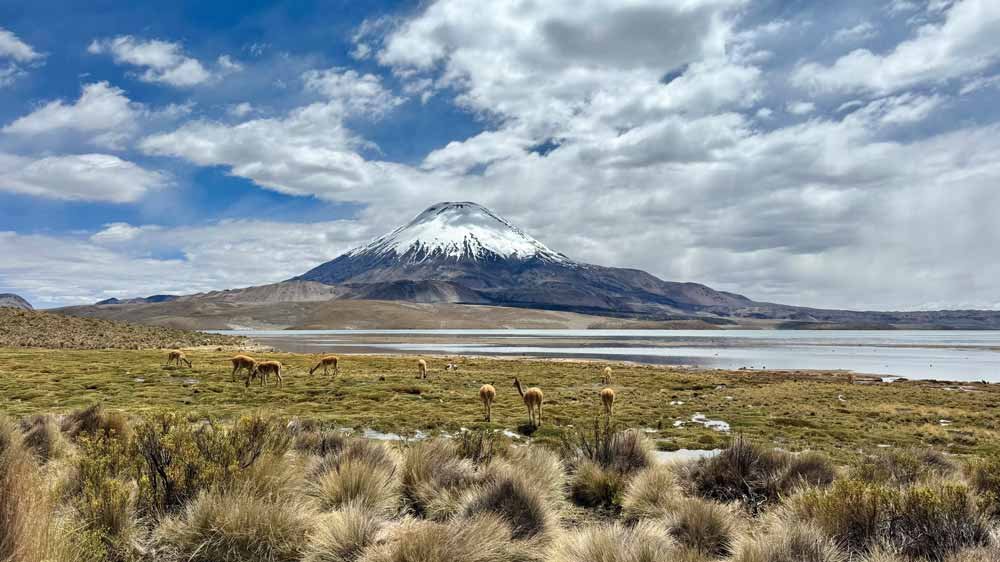
Parinacota volcano rises majestically above Chungará Lake, its snow-covered cone reflected in the still water. In the foreground, vicuñas—the wild ancestors of alpacas—graze calmly in a spongy wetland, while ducks dot the lake. More volcanoes line the far shore, filling the horizon with grandeur.
Though Lauca lies within the Atacama Desert, it receives seasonal rains between December and February. That water replenishes the salty lagoons and nourishes plants such as the strange-looking llareta, which grows atop boulders to resemble cushions, but is so dense it’s as hard as the rock beneath.
A Park without People
Perhaps most astounding, is its emptiness. On a ten-kilometre trek along mostly flat trails, we encounter no one else. Viscachas—rabbit-like rodents—sunbathe on boulders, while water birds patrol the wetlands. When a flock of flamingos lifts off before us their wings flash crimson as they turn in perfect unison, searing the moment into memory.
The park can be busy from June through August, Santiago explains, when European travellers arrive. But winter at this altitude is brutally cold. In October, we enjoy daytime temperatures in the low to mid-teens Celsius, and extraordinary solitude.
Summiting Suriplaza
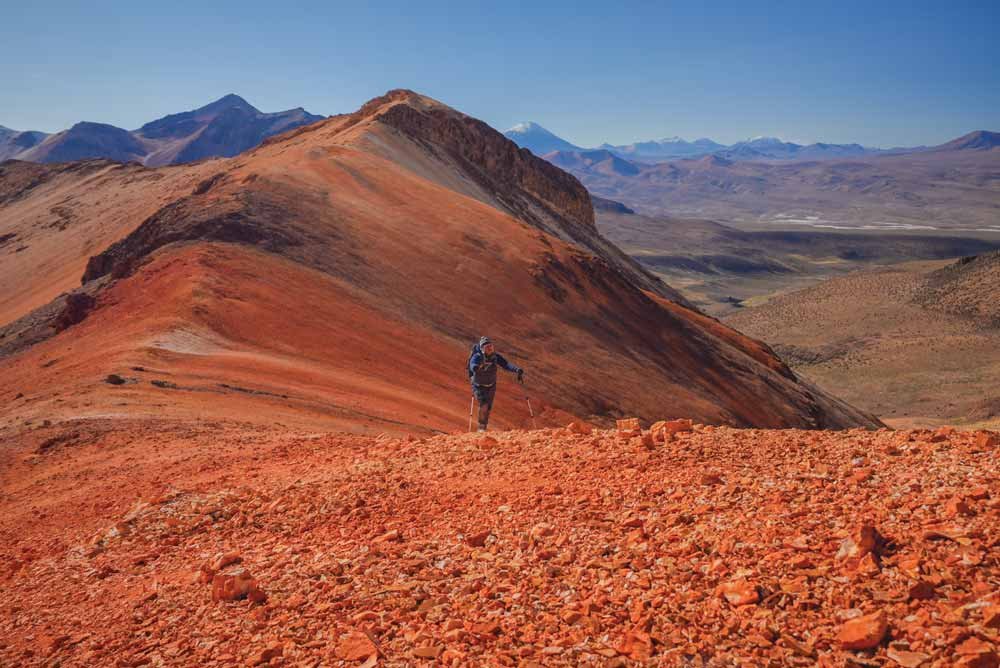
The Suriplaza Rainbow Mountains could be on a different planet. It’s here, on one of the ancient volcanoes, that Alvaro makes his pawa. Afterwards, I take my time climbing to the rim so I can absorb every detail; the ethereal colours, the razor-sharp stones underfoot, the cobalt blue sky, the absolute stillness and quiet.
At the summit, a breathtaking 5,300 metres above sea level, I make my own quiet pawa. Giving thanks to Pachamama, I feel a final surge of awe and humility, keenly aware that in this vast landscape, humans are merely visitors and I’m privileged to be one of the few.