Skip to content

EUROPE
Looking Up in Prague
Ornate rooftops, stirring murals, iconic libraries and contemporary galleries reveal a city where history and creativity collide as Laura Byrne Paquet discovers on this journey.
By Laura Byrne Paquet
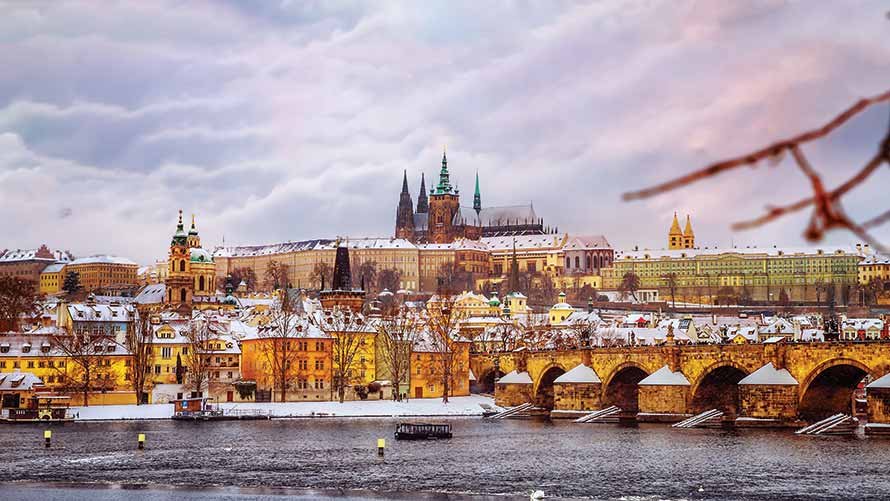
The best advice I receive about touring Prague comes as I’m checking into the Sir Prague Hotel. “Keep looking up,” advises the receptionist. It proves true. As I wander through the Old Town of Czechia’s capital, my eyes climb above the crowds to discover Baroque spires glinting in sunlight, saints standing sentinel along Charles Bridge, and on the opposite bank of the Vltava River, the illuminated towers of Prague Castle.
But it’s on a walking tour with local artist Tereza Tsukahara-Symon that I realize the city’s soul isn’t only in its skyline. It’s written on its walls.
Art Walk in Holešovice
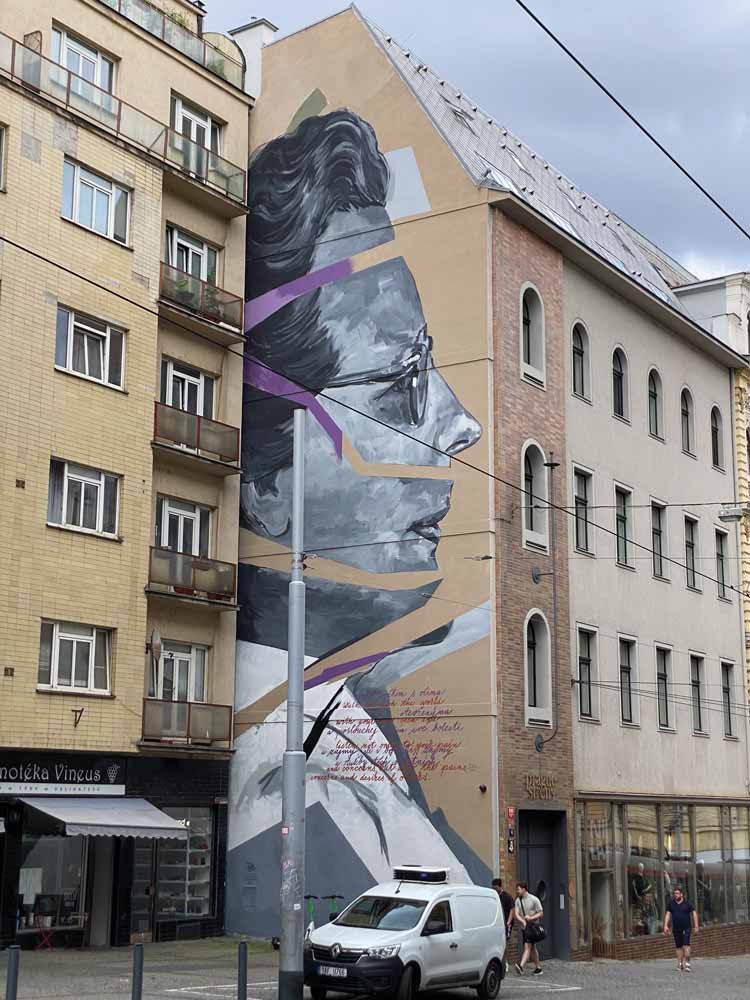
In the artsy Holešovice district, Tsukahara-Symon stops beneath a mural above Milady Horákové Street. Created this past spring by renowned street artist Toy_Box, it portrays Milada Horáková, a Czech politician executed by the Communist regime in 1950. Beneath her stoic profile runs a line from one of her final prison letters: “Walk through the world with your eyes open and listen not only to your pain and concerns, but also to the pains, concerns and desires of others.”
Her words seem to float over the trams rattling below, a daily reminder of resilience in a neighbourhood once known more for industry than inspiration.
Nearby, Holešovice Market is also reinventing itself. Once a bustling cattle market, its 19th- and early 20th-century halls now pulse with cafés, artist studios, a theatre and restaurants, though some buildings still await restoration. “It’s a new history,” says Tsukahara-Symon, “but it’s so interesting how it’s changing so quick.”
We continue to the DOX Centre for Contemporary Art, where white-walled galleries showcase provocative exhibitions. Outside, a fantastical wood-and-steel structure called the Gulliver Airship appears to hover over the rooftop courtyard, a vessel for lectures and performances. On the perimeter wall, I read another reminder that art is life itself: “Art is what makes life more interesting than art.”
Masterpieces and Monuments
The next day I set out to explore Prague’s immense artistic heritage. I spend an enjoyable afternoon delving into Czech art history at the Trade Fair Palace, the National Gallery’s main home. Then I step into a time capsule: the Strahov Library, where thousands of rare volumes line carved wooden shelves. The vaulted ceilings are festooned in frescoes of cherubs and allegories.
But the artistic highlight of my Prague trip is the relocated Mucha Museum, which in 2025 opened in the Baroque Savarin Palace. Alphonse Mucha, the Czech artist who electrified Paris with Art Nouveau posters for actress Sarah Bernhardt in the late 1800s, later devoted over two decades to The Slav Epic, a cycle of 20 monumental canvases chronicling Slavic history.
His fanciful illustrations of women framed in halos of flowers make me smile, and the sometimes-dire scenes in The Slav Epic make me think.
A Hotel that Doubles as a Gallery
After days of art-hopping, I return to the Sir Prague, a boutique hotel that opened in spring 2025. London designer Linda Boronkay has given the interiors a distinctive personality: embroidered headboards, Cubist-inspired chairs, and angular coffee cups beside sleek espresso machines. In the three-storey Sir Grand Suite, sales manager Kristina Gurtlijeva points out furniture specially commissioned from Czech craftspeople. “I love these pieces,” she enthuses, stroking the polished edge of a Cubist desk.
The hotel functions as a gallery of contemporary Czech art, too, with Jana Babincová’s geometric canvases and Marie Lukáčová’s mystical drawings of ancient legends adorning the walls.
One afternoon, with a glass of sparkling wine in hand, I sink into an armchair in the hotel library. General manager Christine Vespermann gestures upward to the Murano glass chandeliers shimmering above us, reminding me once again that the city’s charms aren’t all at street level. When in Prague, it’s always wise to look up.
A Stunning Medieval Town
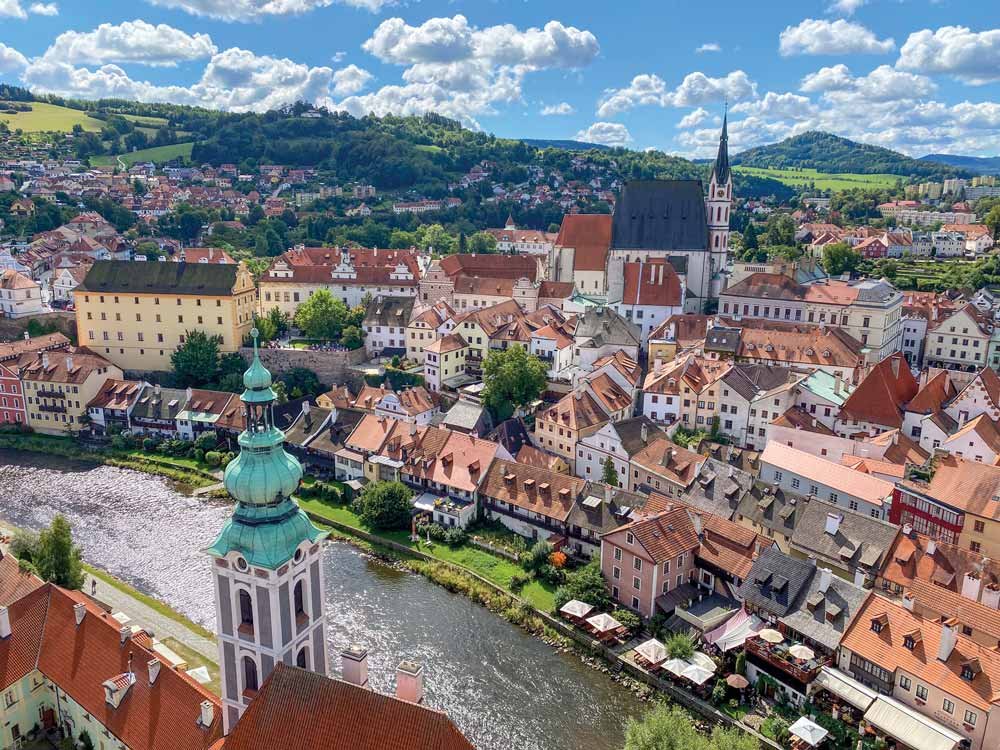
A 2.5-hour trip by car, bus or train from Prague brings you to Český Krumlov, a dreamscape curled along the Vltava River. The town’s red-roofed houses cluster along cobbled lanes, beneath an imposing castle and a neo-Gothic belfry. Though its UNESCO World Heritage status attracts many tourists, you can escape the crowds at two wildly different art galleries: the Egon Schiele Art Centrum, featuring pieces by its namesake and other iconoclastic modern artists; and the Palace of Illustration, showcasing whimsical works created for European children’s books.
Travel Planner
For more travel information about Prague and Czechia, see visitczechia.com