Skip to content

CALIFORNIA
Canvas By The Sea
In Laguna Beach, galleries spill into boardwalks, whale tails breach like brushstrokes, and dinner becomes theatre in this SOCAL artist colony
words and photos By Ilona Kauremszky
I stand before a canvas, a portrait of a bathing beauty gazing beneath a parasol, her eyes lost with the endless blue of the Pacific behind her. The brushstrokes of On the Beach (1917), captured by Laguna Beach native Donna N. Schuster, are so vibrant I can almost feel the sun on my skin. It’s a timeless Southern California (SOCAL) scene, one that poetically captures a moment that exists here. As one of the founders of the Group of Eight, Schuster was immersed in European modernist approaches, embracing a freer, more expressive use of colour.
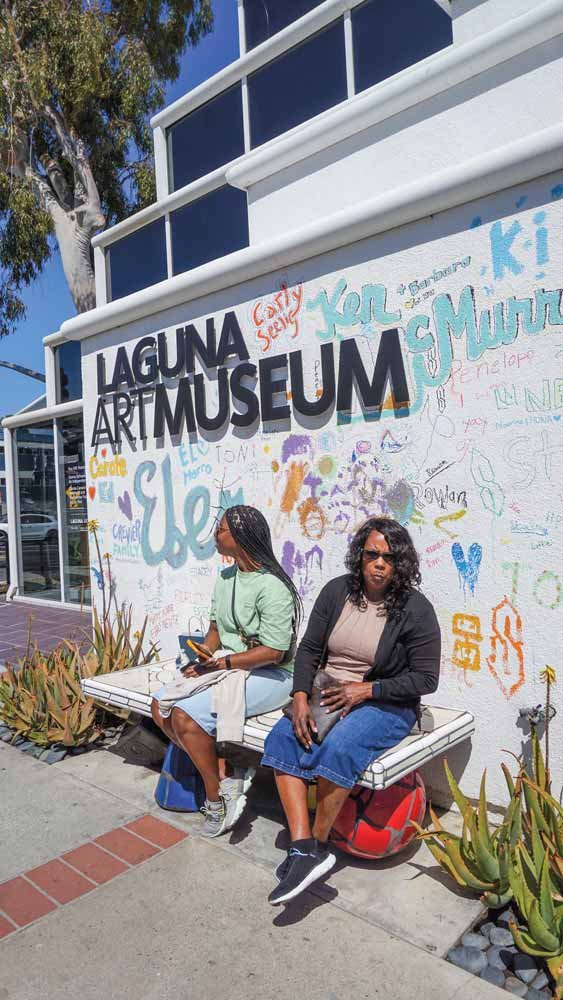
Meanwhile, outside the Laguna Art Museum, cars grind their brakes to a halt as drivers surrender to this seaside village perched between cliff and coast, at the very juxtaposition of the beach and the Pacific Coast Highway. It’s the first of many times I understand that in Laguna Beach, art isn’t only displayed on walls—it seeps into the scenery itself.
This little Orange County jewel, just under 25,000 residents strong, is the heart of California dreaming. Within its 23-square-kilometre radius, celebrities and locals hobnob with an ease that belongs to small-town rhythm. One day I notice NBC Dateline’s Keith Morrison walking his dog, his white hair glowing in the Cali-sun. Here, casual encounters are part of the everyday.
Laguna Beach sits only an hour south of Los Angeles, yet its tempo couldn’t be more different. Landing at John Wayne Airport, the rolling hills reveal themselves in cinematic frames, canyon roads twisting like coiled rattlesnakes toward the sea.
There’s a distinct brand of Wild West here, a freedom that has more to do with pounding surf than pounding freeways. Unlike busy LA, whose lifeblood is concrete and speed, Laguna Beach pulses to the beat of waves.
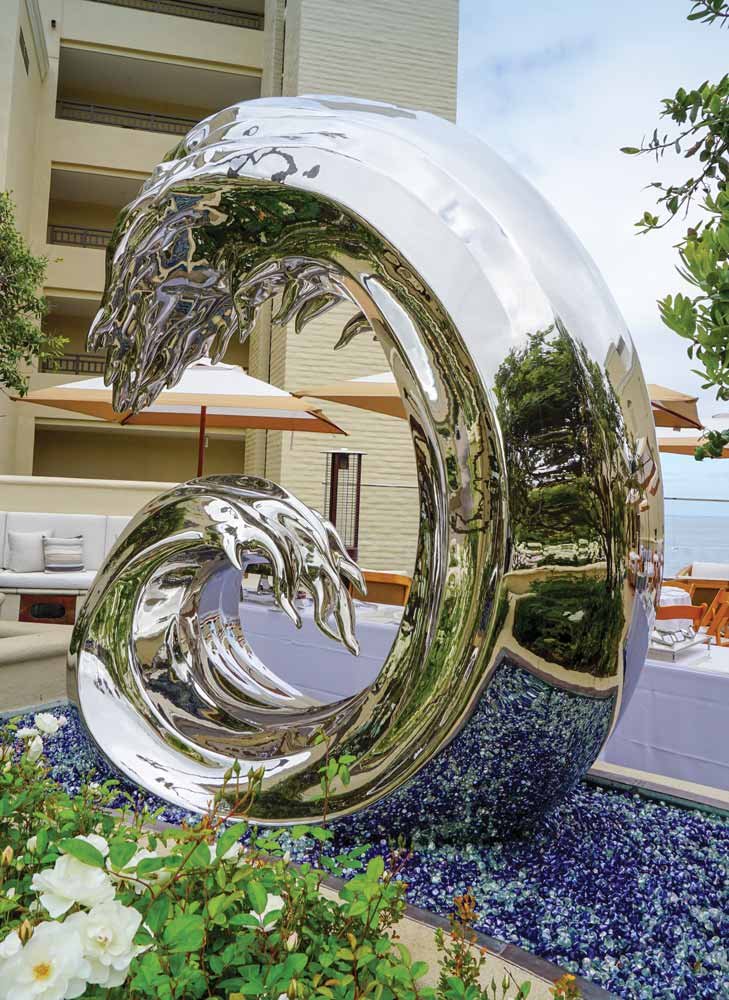
I feel that rhythm instantly at Surf and Sand Resort. The lobby opens like a seashell, drawing me toward windows framing nothing but horizon. Outside a wave sculpture glistens, frozen in a perpetual curl. Its curves symbolize not just the ocean’s power but its promise, too—of renewal, of infinite return. A multi-million-dollar renovation has polished this coastal Grand Dame without stripping away her soul. Modern conveniences—sleek bathrooms, soft linens, and hidden tech—sit comfortably alongside old-school charm. Revered today as a Historic Hotel of America, Surf and Sand attracts weddings, anniversaries, reunions, and milestone celebrations that fuse forever with the sound of surf. Standing barefoot on my balcony, I watch a bride lift her veil into the wind.
Mornings in Laguna Beach are meant for walking. I wander past the former home of Bette Davis, now a private residence, its Spanish colonial bones holding echoes of Hollywood glamour. The coastal alcoves nearby are calm, until a Jason Momoa-like god suddenly rises from the sea, muscles flashing in dawn light. “The water’s warm,” he says, whipping his Aquaman hair back into the morning sky. I laugh, caught between myth and morning coffee.
Laguna Beach’s allure has drawn seekers for over a century. In the late 1800s, visitors made pilgrimages through the canyons each summer, camping by the beach. By 1903, artists began arriving, intoxicated by a light found only here—a clarity that bathed cliffs and sea in shades impossible to mix on a palette indoors. Plein air painting, the art of working outdoors, gained a significant foothold in America here, becoming a hallmark of the city’s artistic identity.
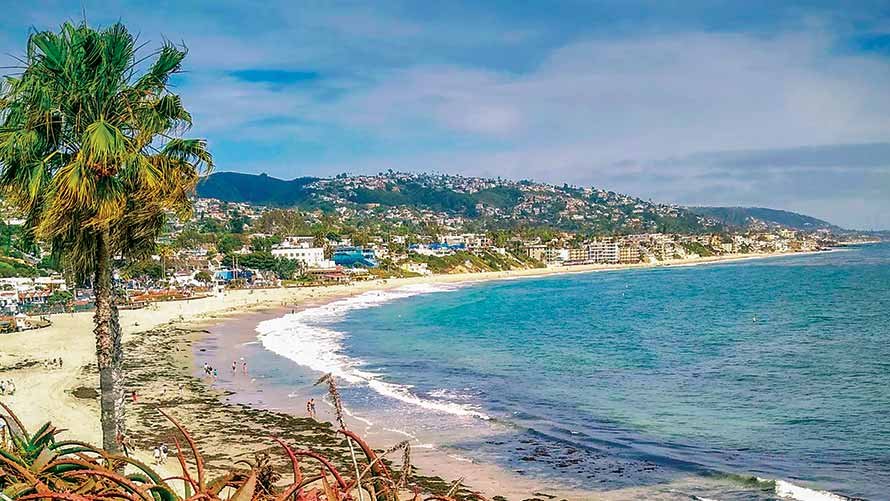
Even today, a stroll along the shore feels like stepping onto a canvas. Surfers carve the waves, their silhouettes backlit against a rising sun. Beachwalks are obligatory. I inhale salt air, hear the ocean’s heartbeat, feel sand sneak between my toes. It’s a tease, because in Laguna Beach, water is king year-round.
On the main drag, PCH, small retro motels rub shoulders with hippie-inspired shops and art galleries. Over 100 of them punctuate the town like brushstrokes in an endless mural. I pass a mechanic tuning up a 1957 jet-black Thunderbird convertible, its hood yawning wide. “She’s a beauty,” he grins, grease streaked across his forearm. I nod, knowing the car could double as a rolling sculpture on this living canvas of a town.
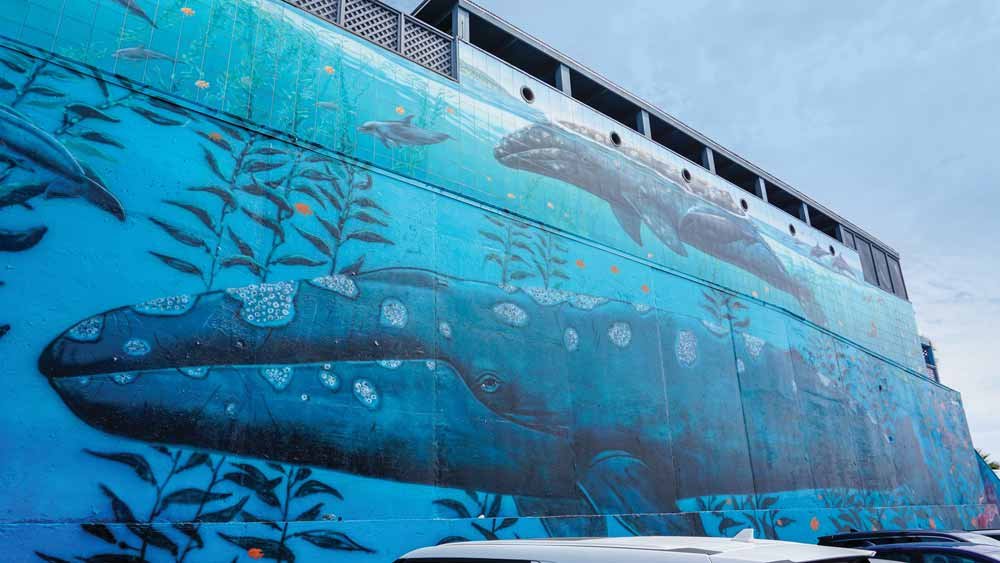
By afternoon, the sun blazes. Families pile onto the legendary boardwalk, where plaques showcase whales, dolphins, sea lions and a bird perch called Bird Rock. The lure proves irresistible. The next morning I head to the “Whale Watching Capital of the World,” a moniker held at Dana Point. On board Dana Wharf Whale Watching, Orange County’s first whale watching company, we’re skimming across the water. I lean over the bow netting and feel like I’m flying above a glassy sea. Suddenly, dolphins torpedo beneath me, their smooth forms slicing the water in choreographed arcs. A grey whale breaches in the distance, its spray catching sunlight like diamonds. It’s ocean theatre, alive and unscripted.
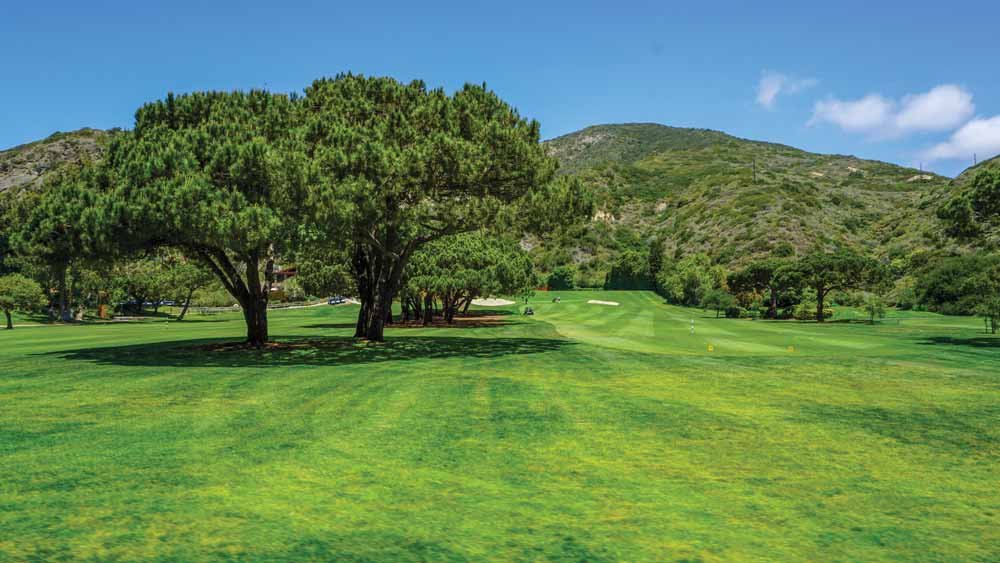
Back on land, I turn inland for Mother Earth’s art. At The Ranch at Laguna Beach, head gardener Leo Goldsmith welcomes me like a gardener-magician. With his Edward Scissorhands flair, he leads me on a farm tour where rosemary and basil release their intoxicating scent. We walk past rows of kale and heirloom tomatoes, the food artfully cultivated for the hotel’s farm-to-table restaurant. Towering eucalyptus trees ring the property, an invasive import from the railway baron era—each stand like sentinels. The Ranch itself is a pastoral counterpoint to Laguna’s beachfront, a retreat cradled by canyon walls where sustainable practices turn every corner into a living installation. Renovated rooms blend rustic textures with modern polish—barn wood, stone and glass reflecting the surrounding wilderness.
On my final day, I stroll downtown, where Laguna’s art-meets-innovation spirit shows its full hand. At Hobie Surf Shop, I linger over surfboards that shaped the very sport, designs born here that transformed wave riding into a global obsession. Just down the street, I catch sight of Rivian, Tesla’s bold EV competitor, also conceived in this seaside nook. Innovation and art, hand in hand.
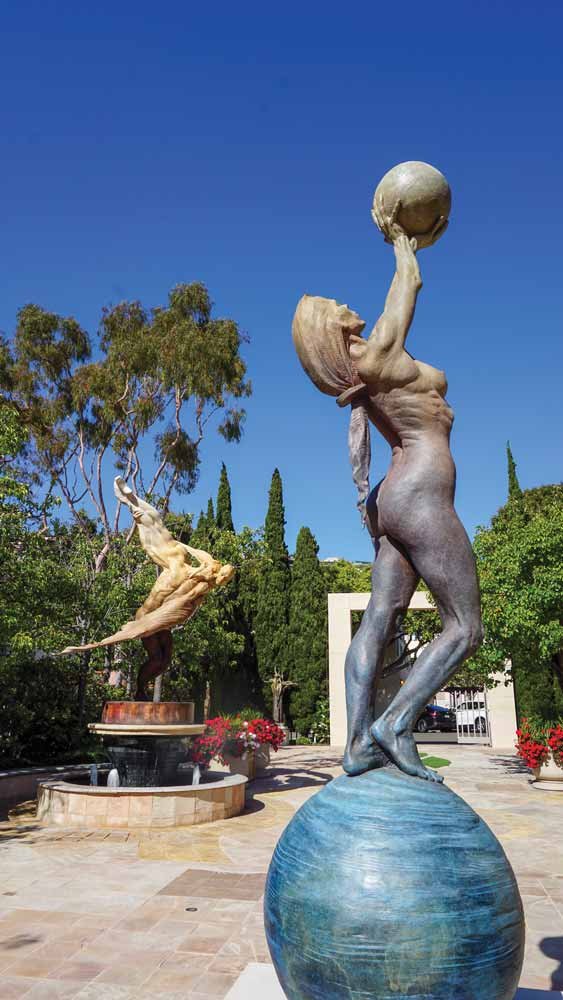
The afternoon takes me to a sculpture garden tucked between streets. Here, bronze figures twist in rhythmic poses, frozen yet alive, circus acrobats locked mid-flight beside avant-garde ballet dancers. I wander among them in quiet communion until an “Open” sign on a discreet door pulls me inside. Dawson Cole Fine Art Gallery morphs into a secret world. Hummingbirds painted on gold and silver leaf glitter on the walls. Bronze bodies gleam under spotlights, every curve seeming to breathe. It’s art that demands presence, much like the town itself.
And then serendipity strikes. Next door lies my dinner reservation—Broadway by Amar Santana. The restaurant hums with New York energy, the open kitchen a stage where chefs play out acts of fire and finesse. I slide onto a counter seat, front row to the performance. Diners trickle in couple by couple, filling the room with low laughter and clinking glasses. I munch through courses of edible theatre—textures, tastes, and sea-born inspirations whipped into dishes that disappear as quickly as they arrive.
As night folds in, I step back onto the street, full and spellbound. Laguna Beach reveals itself not in grand gestures but in the layering of moments—art etched in cliffs, cast on canvas, plated on tables, sculpted in gardens, and carried by waves.
Here, nature is the ultimate artist, and the town its most devoted gallery.
Travel Planner
For more travel information about Laguna Beach, see VisitLagunaBeach.com. Air Canada has year-round flights to John Wayne Airport. For flight information, see aircanada.com