


Page 58 - DreamScapes Magazine | Winter/Spring 2026
P. 58
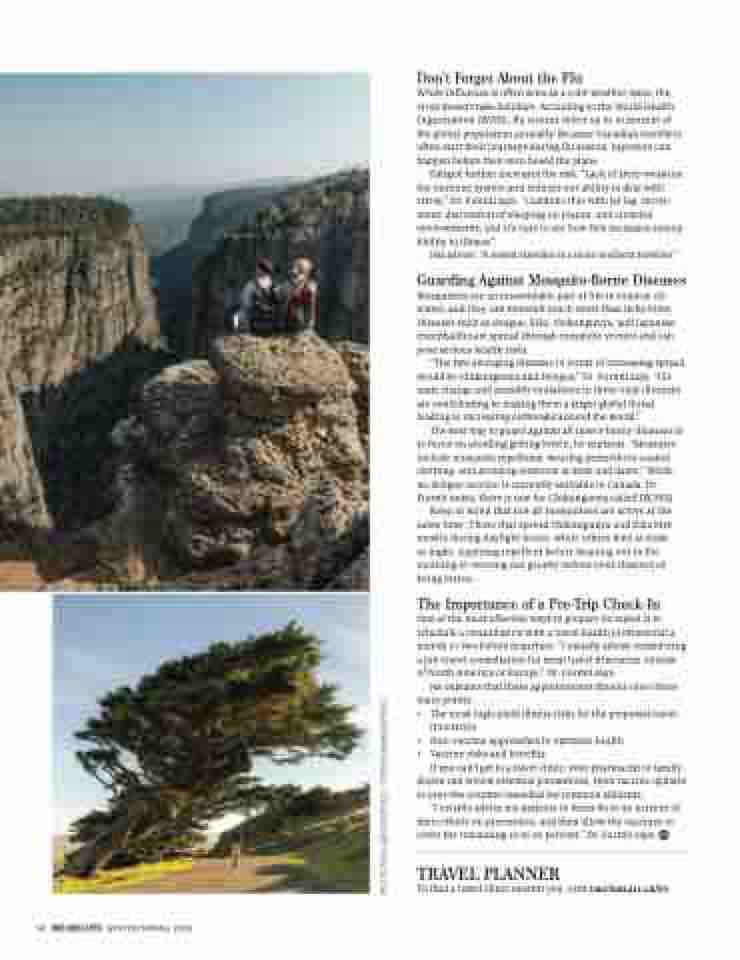
PHOTOS: PAVEL DANILYUK/PEXELS | STEPHEN LEONARDI/PEXELS
58
DREAMSCAPES WINTER/SPRING 2026
Don’t Forget About the Flu
While influenza is often seen as a cold-weather issue, the
virus doesn’t take holidays. According to the World Health
Organization (WHO), flu viruses infect up to 10 percent of
the global population annually. Because Canadian travellers
often start their journeys during flu season, exposure can
happen before they even board the plane.
Fatigue further increases the risk. “Lack of sleep weakens
the immune system and reduces our ability to deal with
stress,” Dr. Furmli says. “Combine this with jet lag, excite-
ment, discomfort of sleeping on planes, and crowded
environments, and it’s easy to see how this increases suscep-
tibility to illness.”
His advice: “A rested traveller is a more resilient traveller.”
Guarding Against Mosquito-Borne Diseases
Mosquitoes are an unavoidable part of life in tropical cli-
mates, and they can transmit much more than itchy bites.
Diseases such as dengue, Zika, chikungunya, and Japanese
encephalitis are spread through mosquito vectors and can
pose serious health risks.
“The two emerging diseases in terms of increasing spread
would be Chikungunya and Dengue,” Dr. Furmli says. “Cli-
mate change and possibly mutations in these viral illnesses
are contributing to making them a larger global threat,
leading to increasing outbreaks around the world.”
The best way to guard against all insect-borne illnesses is
to focus on avoiding getting bitten, he explains. “Measures
include mosquito repellents, wearing permethrin-coated
clothing, and avoiding outdoors at dusk and dawn.” While
no dengue vaccine is currently available in Canada, Dr.
Furmli notes, there is one for Chikungunya called IXCHIQ.
Keep in mind that not all mosquitoes are active at the
same time. Those that spread chikungunya and Zika bite
mostly during daylight hours, while others feed at dusk
or night. Applying repellent before heading out in the
morning or evening can greatly reduce your chances of
being bitten.
The Importance of a Pre-Trip Check-In
One of the most effective ways to prepare for travel is to
schedule a consultation with a travel health professional a
month or two before departure. “I usually advise considering
a pre-travel consultation for most travel itineraries outside
of North America or Europe,” Dr. Furmli says.
He explains that these appointments should cover three
main points:
• The most high-yield illness risks for the proposed travel
itineraries
• Non-vaccine approaches to optimize health
• Vaccine risks and benefits
If you can’t get to a travel clinic, your pharmacist or family
doctor can review essential precautions, from vaccine updates
to over-the-counter remedies for common ailments.
“I usually advise my patients to focus 80 to 90 percent of
their efforts on prevention, and then allow the vaccines to
cover the remaining 10 to 20 percent,” Dr. Furmli says.
TRAVEL PLANNER
To find a travel clinic nearest you, visit vaccines411.ca/en


