


Page 61 - DreamScapes Magazine | Spring/Summer 2026
P. 61
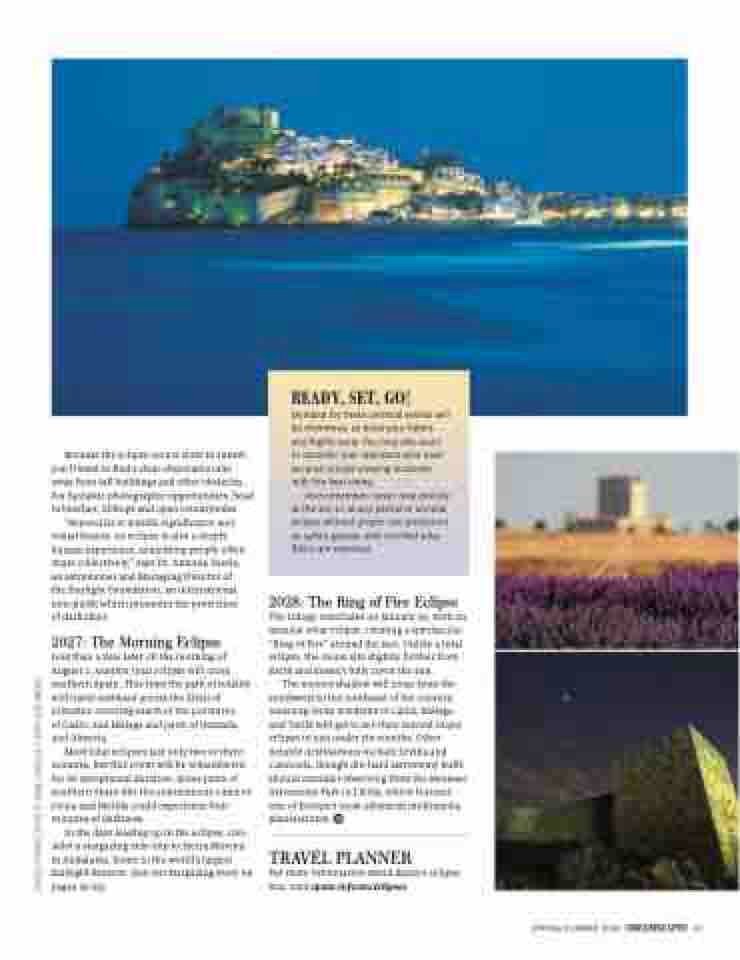
PHOTOS: TOURIST OFFICE OF SPAIN | CASTILLA Y LEÓN | JOSÉ JIMÉNEZ
Because the eclipse occurs close to sunset,
you’ll want to find a clear observation site
away from tall buildings and other obstacles.
For fantastic photographic opportunities, head
to beaches, hilltops and open countrysides.
“Beyond its scientific significance and
visual beauty, an eclipse is also a deeply
human experience, something people often
share collectively,” says Dr. Antonia Varela,
an astronomer and Managing Director of
the Starlight Foundation, an international
non-profit which promotes the protection
of dark skies.
2027: The Morning Eclipse
Less than a year later on the morning of
August 2, another total eclipse will cross
southern Spain. This time the path of totality
will travel eastward across the Strait of
Gibraltar, covering much of the provinces
of Cádiz, and Málaga and parts of Granada
and Almería.
Most total eclipses last only two or three
minutes, but this event will be remembered
for its exceptional duration. Some parts of
southern Spain like the autonomous cities of
Ceuta and Melilla could experience four
minutes of darkness.
In the days leading up to the eclipse, con-
sider a stargazing side-trip to Sierra Morena
in Andalusia, home to the world’s largest
Starlight Reserve. (See our stargazing story on
pages 62-63).
READY, SET, GO!
Demand for these celestial events will
be enormous, so book your hotels
and flights early. You may also want
to consider tour operators who have
secured private viewing locations
with the best views.
And remember: never look directly
at the sun or at any partial or annular
eclipse without proper eye protection
so safety glasses with certified solar
filters are essential.
2028: The Ring of Fire Eclipse
The trilogy concludes on January 26, with an
annular solar eclipse, creating a spectacular
“Ring of Fire” around the sun. Unlike a total
eclipse, the moon sits slightly further from
Earth and doesn’t fully cover the sun.
The moon’s shadow will cross from the
southwest to the northeast of the country,
meaning lucky residents of Cádiz, Málaga
and Tarifa will get to see their second major
eclipse in just under six months. Other
notable destinations include Sevilla and
Catalonia, though die-hard astronomy buffs
should consider observing from the Montsec
Astronomy Park in Lleida, which features
one of Europe’s most advanced multimedia
planetariums.
TRAVEL PLANNER
For more information about Spain’s eclipse
trio, visit spain.info/en/eclipses
SPRING/SUMMER 2026 DREAMSCAPES 61


