


Page 62 - DreamScapes Magazine | Spring/Summer 2026
P. 62
A TRAVELLER’S GUIDE TO SPAIN’S BEST
STARGAZING
DESTINATIONS
BY MARK STACHIEW
that the Milky Way shines bright enough to cast a
Imagine looking up at a night sky so clear and so dark
shadow. If you live in a city, you never get to enjoy that
kind of celestial beauty, which is why you should join
the many visitors flocking to Spain, home to some of the
best dark sky sites in all of Europe.
Spain didn’t become an astrotourism leader by accident.
It’s where the world’s first Sky Law protecting night skies
was introduced. In 1988, the Canary Islands introduced the
pioneering Canary Islands Sky Law, legislation designed to
shield observatories from light pollution. Inspiring the global
Starlight movement, this international declaration
recognized the night sky as a shared scientific, cultural and
natural heritage.
“Protecting the night sky is a collective responsibility,”
says astronomer Antonia Varela, Managing Director of the
Starlight Foundation. “It reminds us where we come from
and that we are part of a much larger universe. Preserving it
ensures that future generations can look up at the stars and
find knowledge, inspiration and a sense of belonging.”
With its vast territories and excellent sky quality, Spain
has become fertile ground for astrotourism and a model of
sustainable tourism for rural communities.
La Palma: The World’s First Starlight Reserve
The Starlight Foundation grants several astrotourism
certifications, the most coveted being the Starlight Reserve,
awarded to regions that actively protect their night skies.
The volcanic island of La Palma was the world’s first to receive
the honour in 2012.
The area’s incredible natural beauty shines by day as well.
The surrounding landscape is shaped by the dramatic
volcanoes of San Antonio and Teneguía. The local visitor
centre offers solar telescope viewing by day and an astro-
nomical viewing point by night. From there, trails wind past
vineyards with sweeping Atlantic views to the stunning
Fuencaliente Salt Flats, where white salt ponds contrast with
black volcanic rock and blue ocean.
Mainland Observatories
Spain’s mainland also hosts numerous Starlight-certified
destinations, many blending astrononomy with local culture
and traditions.
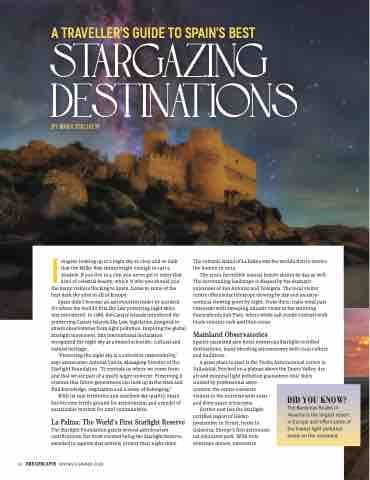
A great place to start is the Tiedra Astronomical Centre in
Valladolid. Perched on a plateau above the Duero Valley, dry
air and minimal light pollution guarantees clear skies.
Guided by professional astro-
nomers, the centre connects
visitors to the universe with solar
and deep-space telescopes.
Farther east lies the Starlight-
certified region of Gúdar-
Javalambre in Teruel, home to
Galáctica, Europe’s first astronomi-
cal education park. With nine
telescope domes, interactive
DID YOU KNOW?
The Bardenas Reales in
Navarra is the largest desert
in Europe and offers some of
the lowest light pollution
levels on the continent.
62
DREAMSCAPES SPRING/SUMMER 2026


