


Page 44 - DreamScapes Magazine | Winter/Spring 2026
P. 44
P A S S I O N P U R S U I T S
The Gorilla Doctor Who Treats Apes and Protects Communities
WORDS AND PHOTOS BY LISA KADANE
THE SCENE
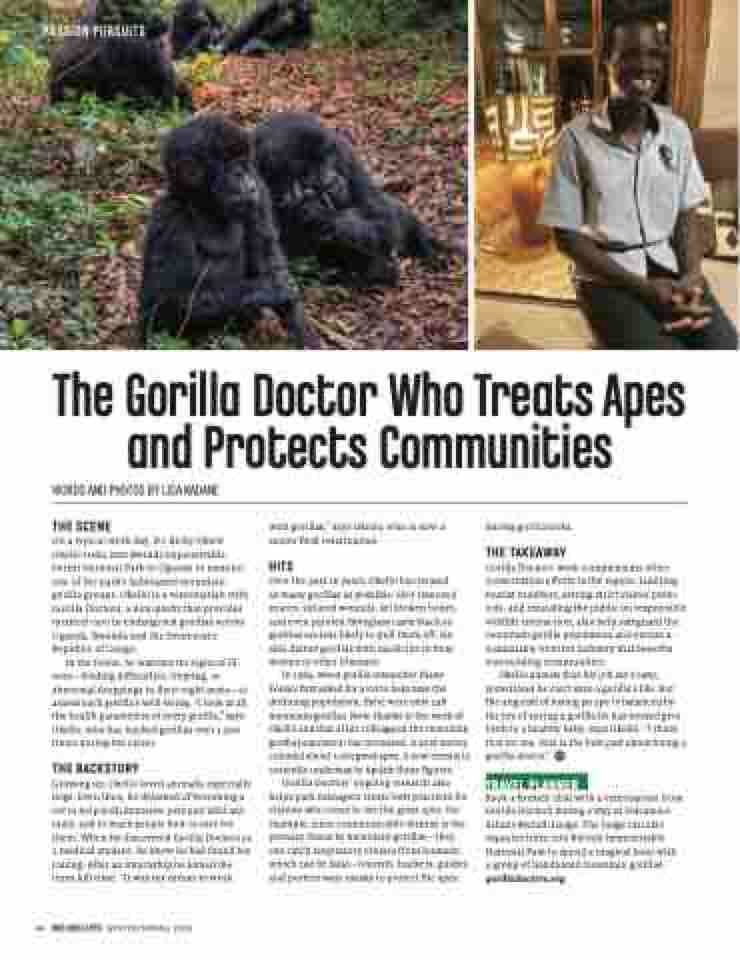
On a typical work day, Dr. Ricky Okwir
Okello treks into Bwindi Impenetrable
Forest National Park in Uganda to monitor
one of the park’s habituated mountain
gorilla groups. Okello is a veterinarian with
Gorilla Doctors, a non-profit that provides
medical care to endangered gorillas across
Uganda, Rwanda and the Democratic
Republic of Congo.
In the forest, he watches for signs of ill-
ness—feeding difficulties, limping, or
abnormal droppings in their night nests—to
assess each gorilla’s well-being. “I look at all
the health parameters of every gorilla,” says
Okello, who has tracked gorillas over 3,500
times during his career.
THE BACKSTORY
Growing up, Okello loved animals, especially
dogs. Even then, he dreamed of becoming a
vet to help both domestic pets and wild ani-
mals, and to teach people how to care for
them. When he discovered Gorilla Doctors as
a medical student, he knew he had found his
calling. After an internship he joined the
team full time. “It was my dream to work
with gorillas,” says Okello, who is now a
senior field veterinarian.
HITS
Over the past 16 years, Okello has treated
as many gorillas as possible. He’s removed
snares, sutured wounds, set broken bones,
and even painted fibreglass casts black so
gorillas are less likely to pull them off. He
also darted gorillas with medicine to treat
worms or other illnesses.
In 1984, when gorilla researcher Diane
Fossey first asked for a vet to help save the
declining population, there were only 248
mountain gorillas. Now, thanks to the work of
Okello and that of his colleagues, the mountain
gorilla population has increased. A 2018 survey
counted about 1,063 great apes. A new census is
currently underway to update those figures.
Gorilla Doctors’ ongoing research also
helps park managers create best practices for
visitors who come to see the great apes. For
example, since communicable disease is the
primary threat to mountain gorillas—they
can catch respiratory viruses from humans,
which can be fatal—tourists, trackers, guides
and porters wear masks to protect the apes
during gorilla treks.
THE TAKEAWAY
Gorilla Doctors’ work complements other
conservation efforts in the region. Limiting
tourist numbers, setting strict visitor proto-
cols, and educating the public on responsible
wildlife interaction, also help safeguard the
mountain gorilla population and ensure a
sustainable tourism industry that benefits
surrounding communities.
Okello admits that his job isn’t easy;
sometimes he can’t save a gorilla’s life. But
the anguish of losing an ape is balanced by
the joy of seeing a gorilla he has treated give
birth to a healthy baby. Says Okello: “I think
that for me, that is the best part about being a
gorilla doctor.”
TRAVEL PLANNER
Book a fireside chat with a veterinarian from
Gorilla Doctors during a stay at Volcanoes
Safaris Bwindi Lodge. The lodge can also
organize treks into Bwindi Impenetrable
National Park to spend a magical hour with
a group of habituated mountain gorillas.
gorilladoctors.org
44
DREAMSCAPES WINTER/SPRING 2026


